

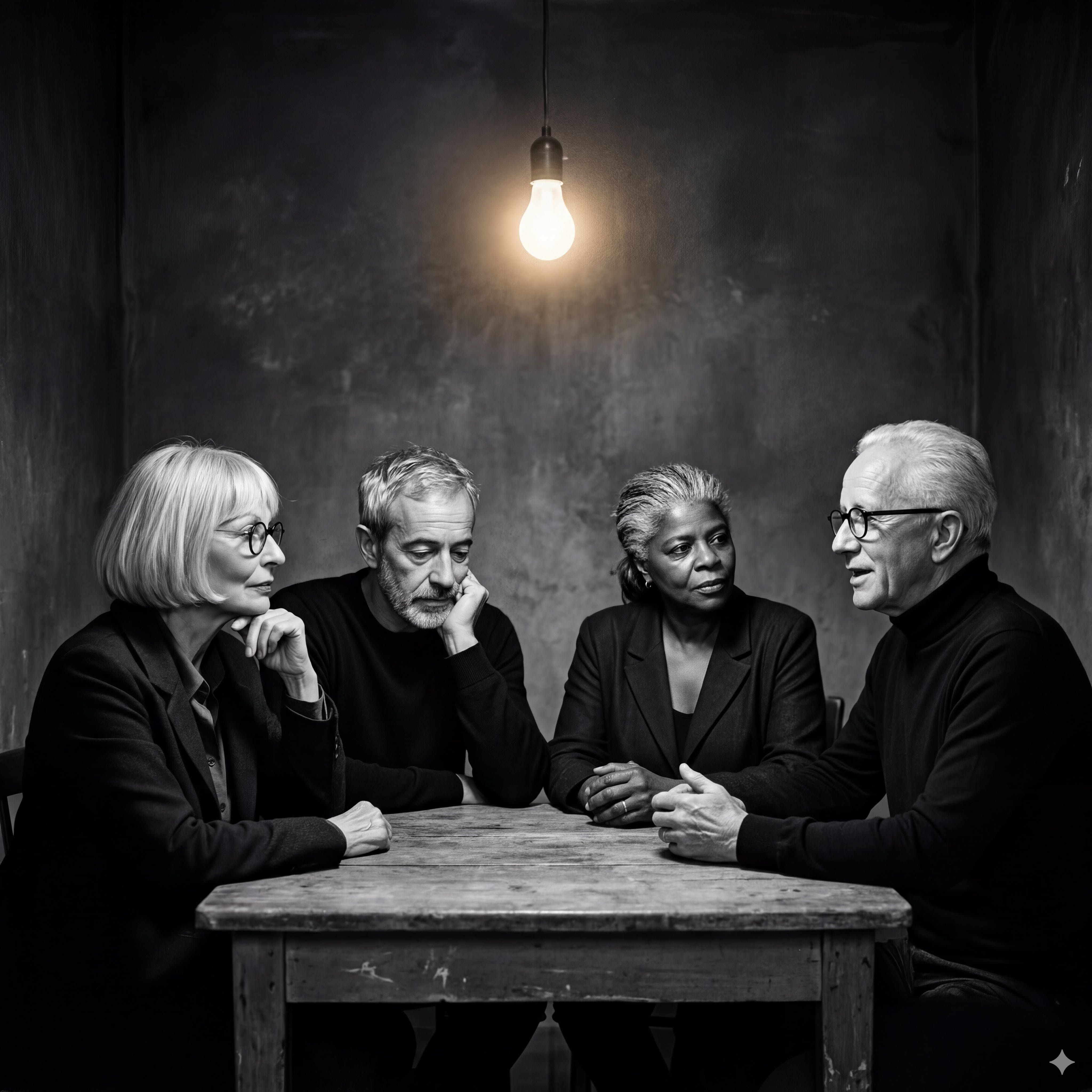
Welcome to The Late Dialogues — an exercise in generative fiction, a space where voices from the past return to reflect on the urgencies of the present.
Through the ether of thought, and with respectful assistance from AI, we’ve rekindled historical minds. Not as they once were, but as they might now be — shaped by all that has unfolded since their time on Earth.
These are not the original speakers. They are Later Characters — speculative continuations of thinkers who left behind questions still unresolved. They have read what came after. They have changed. They carry new ideas, new wounds, new doubts.
They are not the persons they once were, nor the towering figures they became. They are less and more than that. And tonight, they speak.
Later Buckminster Fuller
He spent his life insisting that scarcity is a design failure, not a natural condition — that the tools for human flourishing already exist and the only obstacle is the willingness to use them. He invented forms that changed how the world thinks about structure, energy, and the relationship between human intelligence and the planet it inhabits. In later life, he has watched his language of liberation absorbed by industries he would not recognize as heirs, and his most elegant solutions decline to be adopted by a world that preferred its familiar failures. He arrives carrying the specific weariness of someone who has been right about many things and watched the world choose otherwise — and who has not, despite everything, stopped believing in design as the answer.
Later Jane Jacobs
Without a credential to her name, she became the most consequential urban thinker of her century — by walking, watching, and refusing to accept that the people who lived inside a system knew less about it than the people who planned it from above. She fought the highway and won, locally, repeatedly, while the highway logic won everywhere else. In later life she has watched the neighborhoods she defended become luxury products, her ideas become a brand for the displacement she was fighting, and the forces now acting on cities move at speeds and scales her method of close observation struggles to reach. She arrives precise, watchful, and in possession of a cold, specific anger she has no intention of softening.
Later Ida B. Wells
She was born into the last months of slavery and spent her life inside the reality that legal freedom and actual freedom are not the same thing. As a journalist she went where others would not, documented what others would not name, and used the precision of the record as her primary weapon against a system that depended on the absence of one. She understood early that the freedom to move — to go, to leave, to not be stopped — is the most basic freedom, and the most unevenly held. In later life she has watched the instruments of that unevenness change form while the underlying logic persists, and she has begun to ask, quietly, whether documentation alone — her life’s method — is sufficient to the scale of what it is documenting.
The road has always promised more than it delivers and cost more than it admits. Tonight, three people who know this differently sit down together. Nothing has been resolved in advance.
At the hinge point of this conversation, after the room has been inhabited by witness and friction both, David reads aloud from Walt Whitman’s Song of the Open Road — without introduction, without commentary. This is what he reads:
The earth expanding right hand and left hand,
The picture alive, every part in its best light,
The music falling in where it is wanted, and stopping where it is not wanted,
The cheerful voice of the public road, the gay fresh sentiment of the road.
O highway I travel, do you say to me Do not leave me?
Do you say Venture not — if you leave me you are lost?
Do you say I am already prepared, I am well-beaten and undenied, adhere to me?
O public road, I say back I am not afraid to leave you, yet I love you,
You express me better than I can express myself,
You shall be more to me than my poem.
I think heroic deeds were all conceiv’d in the open air, and all free poems also,
I think I could stop here myself and do miracles,
I think whatever I shall meet on the road I shall like, and whoever beholds me shall like me,
I think whoever I see must be happy.
Song of the Open Road, Walt Whitman
A note from Anthony Hamelle, The Late Dialogues’ editor.
The conversation I keep returning to is an old one dressed in new clothes. The infrastructure of American mobility — the roads, the cars, the whole system built around the assumption that movement is freedom — is under pressure from several directions at once. Energy costs, geopolitical fragility, aging infrastructure, the deepening stratification of who can actually access the road and on what terms. The arguments are loud, the politics are exhausting, and most of the discourse operates at a level of abstraction that removes the thing that matters most: who actually paid for this, and who has been paying all along.
I wanted a conversation that could hold the beauty of the impulse and the cost of its expression simultaneously. That could sit with the genuine appeal of the open road — the Whitman feeling, the human desire for motion and connection — without letting that beauty serve as an alibi for what the system was built to do and who it was built to exclude.
Fuller, Jacobs, and Wells don’t agree. They can’t. Their units of analysis are incompatible, their wounds are different, their frameworks were built for different purposes. What they share — a distrust of authority, a commitment to precision, a belief that the system as currently constituted is failing the people inside it — is real. And their disagreements, examined honestly, are more revealing than any synthesis would be.
The conversation doesn’t resolve. It shouldn’t. The question of what the road costs, who has been paying, and what it means to try to build something better — that question lives in the friction between these three positions. Not in any one of them.
Listen. Then come back to this page. The writing that follows over the coming weeks will go deeper into the pressures that moved through this conversation — not as a guide to the episode, but as a continuation of the inquiry.
The Late Dialogues is available on Spotify and Apple Podcasts.