

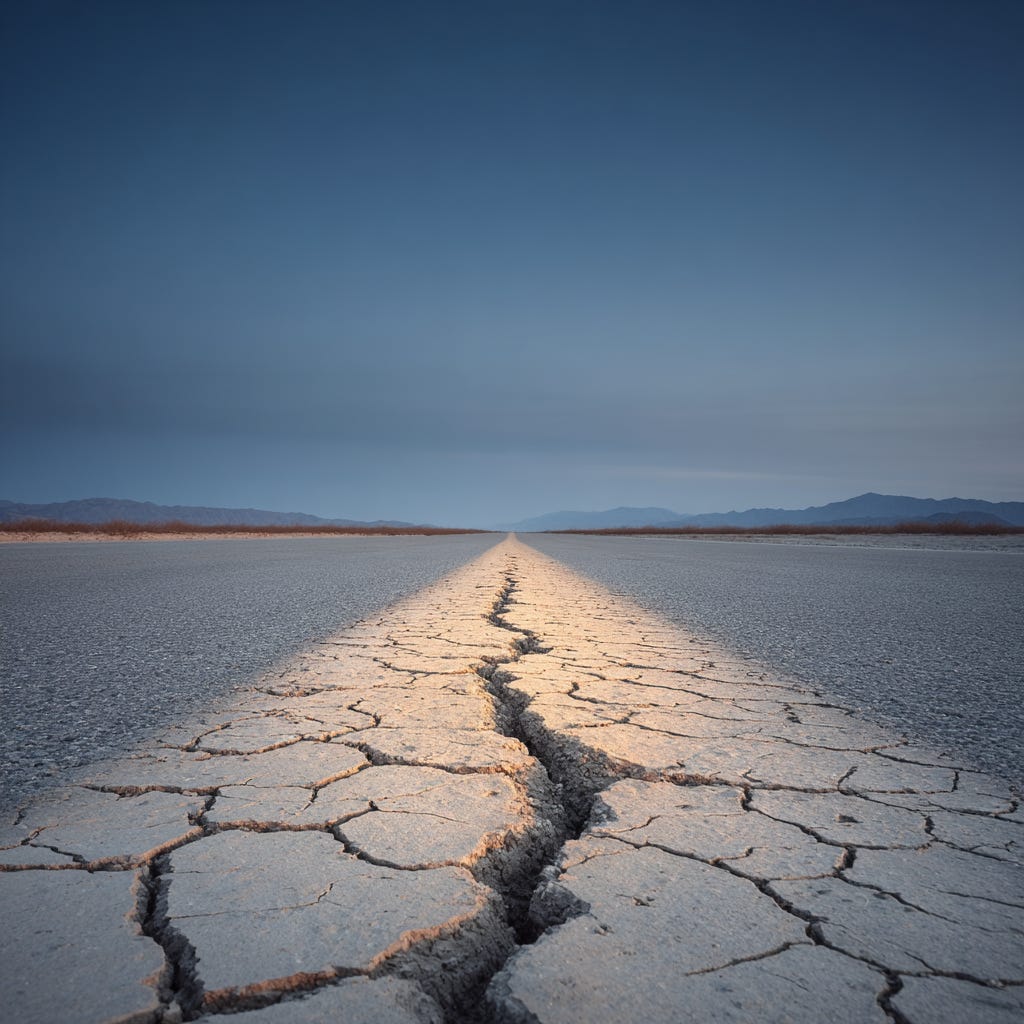
There is a particular kind of mythology that doesn’t describe the world — it makes it possible. It generates the consent required to build things that couldn’t be built if people looked too directly at what they cost.
The mythology of the American road is like that. The frontier, the highway, the open road — these were never simply stories told about a system that already existed. They were the stories that made the system politically possible. They absorbed the cost. They made the extraction legible as progress, the displacement legible as expansion, the exclusion legible as the natural order of things moving forward.
For a long time, the mythology held. It was genuinely beautiful, which helped. Walt Whitman felt something real when he wrote about the road — the democratic promise of movement, the expansiveness of a continent that seemed to have no walls. That feeling was not fabricated. The impulse it expressed — toward connection, toward horizon, toward the next place — is one of the oldest human impulses there is. The mythology was powerful because it was attached to something true.
But a mythology is not the same as the truth it’s attached to. And the gap between the two has always been where the cost was hidden.
The cost of building the system. The cost of fueling it. The cost borne by the people who were moved rather than moving — displaced to make room for the infrastructure of other people’s freedom. The cost carried by the communities through which the highways were routed, not past them. The cost of the land before it was declared open. The cost that was never put on the invoice because the invoice was never addressed to the people paying it.
None of this is new information. The cost has always been there, carried by the people who couldn’t look away from it because it was being paid with their lives and their neighborhoods and their freedom to move without being stopped.
What is new — or newly visible — is that the mythology is losing its grip. Energy is no longer cheap or politically neutral. The infrastructure is aging and contested. The geopolitical order that underwrote American mobility is under pressure from directions that can’t be managed by looking the other way. The bill is arriving. Not for the first time. But with a clarity that the culture can no longer absorb by invoking the open road.
The question this opens is not primarily economic or political, though it has economic and political dimensions. It is a question about identity. About what a culture does when the story it built itself on becomes harder to tell with a straight face. About whether the impulse that generated the mythology — the genuine human longing for movement, for horizon, for the next place — can survive an honest accounting of what it cost to express it this way.
That question is not new either. It has been sitting in the room for a long time, asked by people who never had the luxury of not asking it. What may be new is that more people are in the room now. And the room is getting smaller.
There is a line in Whitman’s Song of the Open Road that moves me. He is arguing with the road — which is itself interesting, that the poet of American expansion felt the need to argue with the thing he was celebrating. O public road, I say back I am not afraid to leave you, yet I love you. There is something in that ambivalence that feels more honest than the pure celebration. He felt the road’s demand. Its claim on him. Its insistence that without it, you are lost.
He pushed back. But he loved it anyway.
We are somewhere in the middle of that argument now. Not past it. Not resolved. The road is still making its claim. The bill is still arriving. The question of who pays it, and who always has, is still the question underneath every other question.
That is what we are here to sit with.
The Open Road’s Bill — a new episode of The Late Dialogues — arrives early April.